Today’s reading is from the Jerusalem Bible version of the Gospel of Luke, Chapter 13, verses 22 to 30:
“Through towns and villages Jesus went teaching, making his way to Jerusalem. Someone said to him, ‘Sir, will there be only a few saved?’ He said to them, ‘Try your best to enter by the narrow door, because, I tell you, many will try to enter and will not succeed. ‘Once the master of the house has got up and locked the door, you may find yourself knocking on the door, saying, “Lord, open to us” but he will answer, “I do not know where you come from.” Then you will find yourself saying, “We once ate and drank in your company; you taught in our streets” but he will reply, “I do not know where you come from. Away from me, all you wicked men!” ‘Then there will be weeping and grinding of teeth, when you see Abraham and Isaac and Jacob and all the prophets in the kingdom of God, and yourselves turned outside. And men from east and west, from north and south, will come to take their places at the feast in the kingdom of God. ‘Yes, there are those now last who will be first, and those now first who will be last.’” This is the Word of the Lord. Thanks be to God.
In the Gospel of St. Luke, much emphasis is placed upon compassion, human tenderness, and the mercy of Christ. Within its pages are the parable of the Prodigal Son, and the story of the repentant thief, who records Jesus’ final words: a prayer for forgiveness to God to cover the sins that flow from the ignorant acts of humanity. We read that Jesus is the Messiah, the Herald of mercy and eternal life, and the Savior of us all. However, in today’s passage, we are reminded of an uncomfortable part of Jesus’ message: the part which reminds us that not all will be saved.
It is this uncomfortable part which probably prompted the question at the beginning of the passage: “Sir, will there be only a few saved?” Jesus did not give a direct answer, and so the hidden mysteries behind God’s will would remain unknown to us. Instead, Jesus gave us all some good, practical advice. He exhorted us to be single-minded in our determination to follow God. We are to do everything within our power to make it through the narrow gate into Life Everlasting.
The original audience of Jesus would have known of the little postern gate in a walled city. They would have known that the merchants could not have entered through that gate without putting down their burdens and leaving their wealth behind. In contrast, the crowds entering through the wide, main gate would not even notice it. The easy way of the many into to the city led to their destruction. But, Jesus does not stop here with the analogy of the narrow door. Next, we find that the door is closed. Much like the five foolish virgins in the Gospel of Matthew, those left on the other side would be disowned and left to their fate.
This part of Jesus’ message is important for us to hear today. It is easy to appropriate tropes of Christ’s example, such as his great love for the ignored and the oppressed or his disdain for religious elites, and then try to separate Christ from Christianity. It is easy in our relatively comfortable, largely secular Western society, to say that everything goes and that everyone will be saved. If that really were so, there would be no obligation upon the Christian to evangelize. There would be no obligation upon us to live out moral or particularly virtuous lives. In that complacent, fantasy world of faith, God’s anger is never kindled. The example of the saints is merely quaint and old-fashioned. To live in that fantasy world, we should focus upon wellness rather than faith and self-realization of the bright light within and rather than humility before the Lord. This cannot be so.
Today’s passage is a warning to all of those who think they have the right answer. We cannot appropriate and domesticate any part of the Gospel that makes us feel good about how we are living our lives while dismissing the bits we do not like as being too dogmatic and controlling. We have to accept all of it – especially the parts that we might not like or understand. Just as grief is the price for love, so faithfulness and humility unto the Lord is the price for our salvation.
Instead of looking outward at appearances, at trinkets and temporal treasures, we must look within. We must build a relationship with God through devotion, education, prayer, the reading of Scriptures, the performance of service to humanity, and through worship. Only then can we live like the merchants, who were able to enter the walled city through the narrow gate. Only then can we put down our burdens into the trust of our Lord, leaving the perceived wealth of this world behind. Only then can we have the grace and favor of God, as we seek to live like the last who will become the first. Amen and Amen.
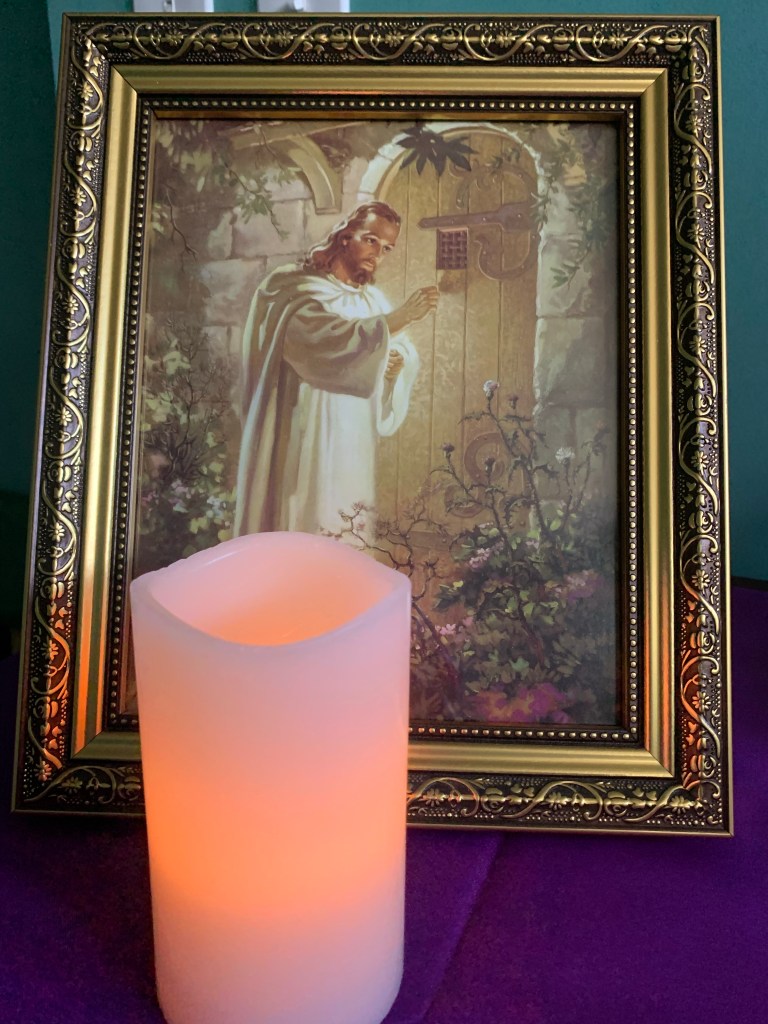
 The Good Shepherd